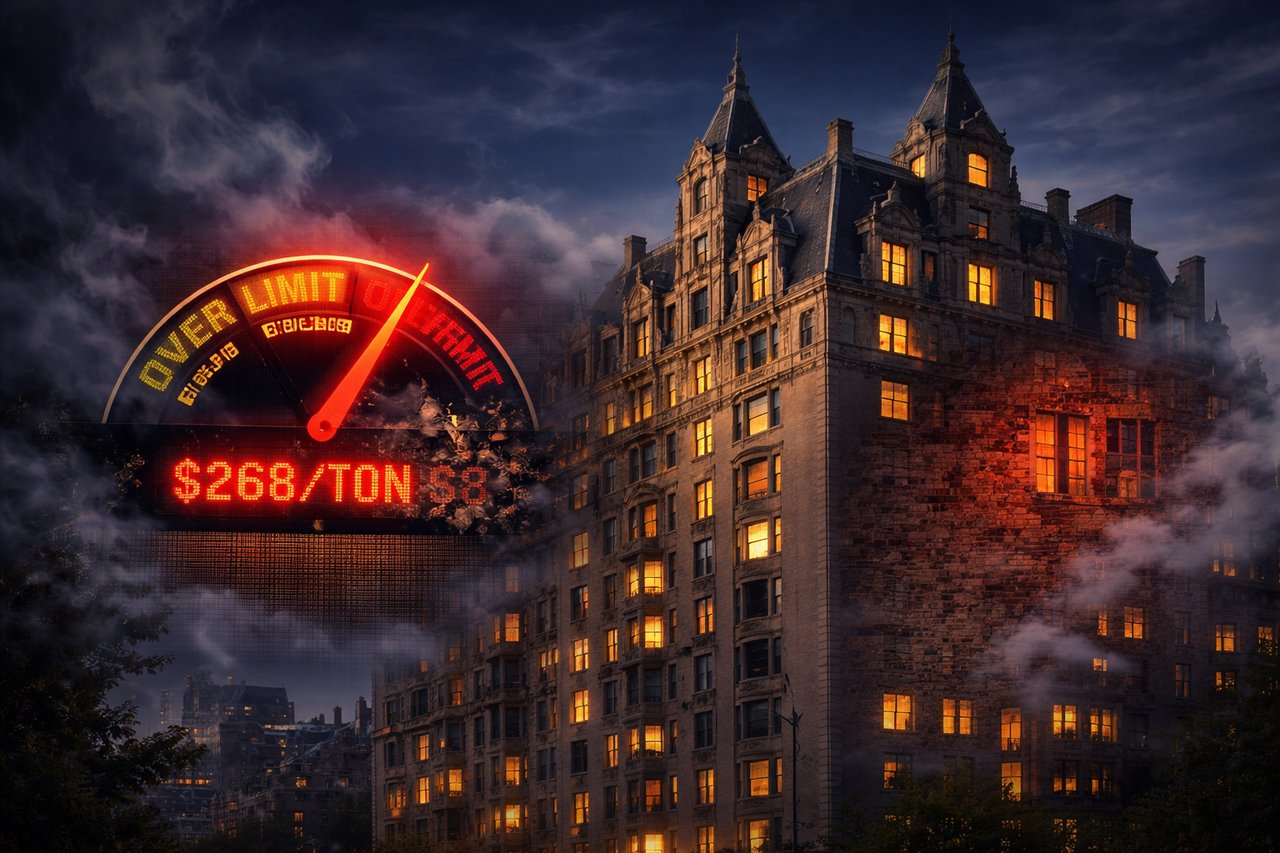
A pre-war co-op on the Upper West Side. Solid building, well-maintained, loyal shareholders. Then the board receives its first NYC Local Law 97 compliance report and discovers the building is 47 metric tons over its annual carbon limit.
At $268 per ton, that is $12,596 in fines for 2024 alone. Across five compliance years with no changes made, over $60,000 in cumulative penalties before the far stricter 2030 limits even kick in.
This is not a future problem. The fines began in 2025. The question is whether your building is already paying them, and whether you know it.
Here is the full blog post, written tight, mobile-optimized, every section from the outline included:
What Is Local Law 97 and Which Buildings Does It Cover?
Local Law 97 is New York City's building carbon emissions law, enacted in April 2019 as part of the Climate Mobilization Act. Buildings account for nearly 70% of NYC's total greenhouse gas emissions, LL97 targets the existing building stock, not just new construction. The goal is a 40% reduction in building emissions by 2030, 80% by 2050, and net zero by 2050.
Covered buildings include:
-
Single buildings over 25,000 gross square feet
-
Multiple buildings on the same tax lot totaling over 50,000 square feet
-
Two or more condo buildings governed by the same board that together exceed 50,000 square feet
Approximately 50,000 buildings citywide fall under the law, covering roughly 75% of NYC's total built square footage. If you own in a large co-op or condo tower in Manhattan, Brooklyn, or Queens, your building is almost certainly on the list.
Buildings under 25,000 square feet are not covered. Landmarked buildings are not automatically exempt, owners can apply to DOB for an emissions limit adjustment if preservation restrictions physically prevent certain upgrades.
The Four Compliance Periods: Where Your Building Stands Right Now
LL97 operates in four periods with progressively tighter emissions caps.
2024–2029 - current period: First annual emissions reports were due May 1, 2025, covering 2024 energy use. Reports are filed at nyc.beam-portal.org and must be certified by a Registered Design Professional. Late filing: $0.50 per square foot per month. False reporting: up to $500,000 in fines. According to DOB's preliminary review, 89% of covered buildings comply for this period. The 11% that do not are already receiving penalty bills.
2030–2034 - the crunch: This is where the real pressure hits. Limits tighten by approximately 40% from today's caps. According to Urban Green Council analysis, 57% of covered properties currently emit more than their 2030 allowance. City projections put the figure at 63%, meaning nearly two-thirds of NYC's covered buildings will be non-compliant by 2030 if nothing changes.
2035–2049 and 2050: Deep retrofit requirements escalate through this period. Net zero emissions are required by 2050.
One important note: NYC's electricity carbon coefficient is expected to drop approximately 50% by 2030 as the grid gets cleaner. Buildings that electrify heating and cooling systems now will automatically benefit, the same electricity will carry half the carbon penalty by decade end.
How the Penalty Is Calculated and What It Actually Costs
The formula is straightforward:
Penalty = (actual emissions − building's annual limit) × $268 per metric ton of CO₂
The fine recurs every year the building stays over its limit. And LL97 penalties are not tax-deductible.
What this looks like in real numbers:
-
50,000 sq ft building - 50 tons over limit - $13,400/year
-
100,000 sq ft building - 132 tons over limit- $35,376/year
-
Large luxury tower - 500+ tons over limit - $134,000+/year
What drives high emissions in NYC buildings:
-
Old gas-fired or fuel oil boilers - the single biggest driver in pre-war buildings
-
Poor building envelope - aging insulation and windows
-
No building automation or energy monitoring system
Compliance paths to reduce or eliminate penalties:
-
HVAC and boiler upgrades - switching from fuel oil to heat pumps or natural gas
-
Building envelope improvements - insulation, window replacement
-
Onsite solar or battery storage - deducted from total reported emissions
-
Renewable Energy Credits (RECs) - purchased to offset annual emissions
-
Affordable Housing Reinvestment Fund (AHRF) offsets - same $268/ton cost as the fine itself, but the payment funds affordable housing rather than going to the city as a penalty
-
Good Faith Effort pathway - buildings actively working toward compliance with a documented decarbonization plan can access limited fine protection through the 2024–2029 period
Who Actually Pays: Co-op Shareholders and Condo Unit Owners
The legal obligation under LL97 falls on the building owner. In a co-op, that is the co-op corporation. In a condo, that is the association. The building pays the fine.
But the building funds its operations through you, through maintenance fees in a co-op and common charges in a condo.
In practice, non-compliance fines, capital upgrade costs, and compliance expenditures are all passed to shareholders and unit owners through maintenance increases, common charge increases, or special assessments.
What this means right now:
-
A co-op shareholder in a pre-war building with an aging boiler may face a maintenance increase or special assessment to fund either the upgrades or the annual penalties
-
A condo unit owner in a building that has not started 2030 compliance planning may face a large capital assessment in 2028–2029 for rushed last-minute HVAC work
-
Non-compliant buildings are increasingly being discounted by lenders and buyers, LL97 exposure is showing up in appraisals
-
Buildings achieving early compliance are being recognized as better long-term investments, lower operating costs, lower regulatory risk, stronger resale values
Financing options available to boards:
-
PACE loans, repaid through property tax assessments, available to most co-ops and condos
-
NYC Accelerator, a free city-sponsored program providing technical guidance to buildings navigating compliance
-
Performance contracting through ESCOs (Energy Service Companies), the ESCO designs, finances, and guarantees energy savings; useful for buildings with limited reserves
Our team at Batra Real Estate regularly works with buyers to assess LL97 exposure as part of evaluating any large NYC building purchase. It is a standard part of what we review, not an afterthought.
Five Questions to Ask Before You Buy in a Large NYC Building
If you are currently searching for a Manhattan, Brooklyn, or Queens apartment, these five questions should be part of every conversation with the seller or managing agent before you make an offer.
1. Is this building on the LL97 Covered Buildings List?
Check at nyc.gov or ask your agent to verify. Coverage is based on square footage, confirm the building's status before assuming the law applies or does not apply to it.
2. What were the building's 2024 emissions versus its limit?
The annual report filed by May 2025 is a public record. A building that exceeded its 2024 cap is already paying fines, and those fines recur every year without action. Ask for the report before making an offer.
3. Are any LL97-related capital projects planned or in progress?
Board minutes and the building's capital plan will tell you whether a boiler conversion, HVAC replacement, or envelope upgrade is on the roadmap. Any major project can result in a special assessment that falls on whoever owns the unit at the time of the vote.
4. Has the board filed a decarbonization plan or Good Faith Effort application?
A documented plan signals that the board is managing the problem proactively. No plan in place, particularly in an older building, is a yellow flag heading into the 2030 compliance crunch.
5. What is the building's projected compliance status for 2030?
The 2030 limit is roughly 40% stricter than today's cap. A building barely compliant now is likely non-compliant by 2030. Ask the managing agent for a projected compliance assessment before committing.
For buyers also navigating ownership structure decisions, our guide to buying NYC property through an LLC covers what has changed in 2026 and what questions to address before closing.
The Clock Is Running - Know Your Building Before You Buy
NYC Local Law 97 has moved from a coming concern to a present cost. The 11% of buildings already over their limits are paying fines today. The 63% projected to exceed 2030 caps are carrying a regulatory risk that has not yet shown up on the price tag, but will.
For anyone buying a New York City apartment in a large building, understanding LL97 exposure is no longer optional. It belongs in your due diligence stack alongside the financial statements, the reserve fund balance, and the board minutes.
At Batra Real Estate, we evaluate Local Law 97 compliance status as a standard part of every buyer transaction in covered buildings. We know which Manhattan, Brooklyn, and Queens buildings are ahead of the law, which are mid-upgrade, and which are carrying unresolved exposure heading into the 2030 crunch. Our team helps you ask the right questions before you make an offer, not after you close.
Start the conversation with our team before your next NYC purchase, or browse current listings with LL97 compliance as part of your evaluation criteria from day one.
Frequently Asked Questions
What is NYC Local Law 97 and does it affect my apartment?
Local Law 97 sets annual carbon limits for most NYC buildings over 25,000 square feet, with fines of $268 per metric ton for excess emissions. If you own in a covered co-op or condo, any fines or compliance costs will flow through to your maintenance fees or common charges.
When did Local Law 97 penalties start?
Penalties began with the 2024 compliance year. Annual reports were due May 1, 2025, and fines are now being assessed on buildings that exceeded their 2024 limits. Every year a building remains non-compliant, the fine recurs at $268 per ton.
How much can Local Law 97 fines cost a building?
A 100,000 square foot building that is 132 metric tons over its limit faces $35,376 in annual fines. Larger luxury buildings significantly over their limits can face six-figure penalties every year. Fines are not tax-deductible and compound with each non-compliant year.
What should I ask before buying an apartment in a large NYC building?
Ask for the building's most recent LL97 emissions report, its current compliance status, whether capital projects are planned, and the building's projected position for the 2030 compliance period, when limits tighten by roughly 40%. A non-compliant building heading into 2030 without a plan is a measurable financial risk for every owner inside it.
This article is for informational purposes only. Consult a licensed building engineer and legal counsel for advice specific to your building and situation.